May 30Old World Order: Strategic Lessons Shaping China’s Rise Amid Demographic Decline
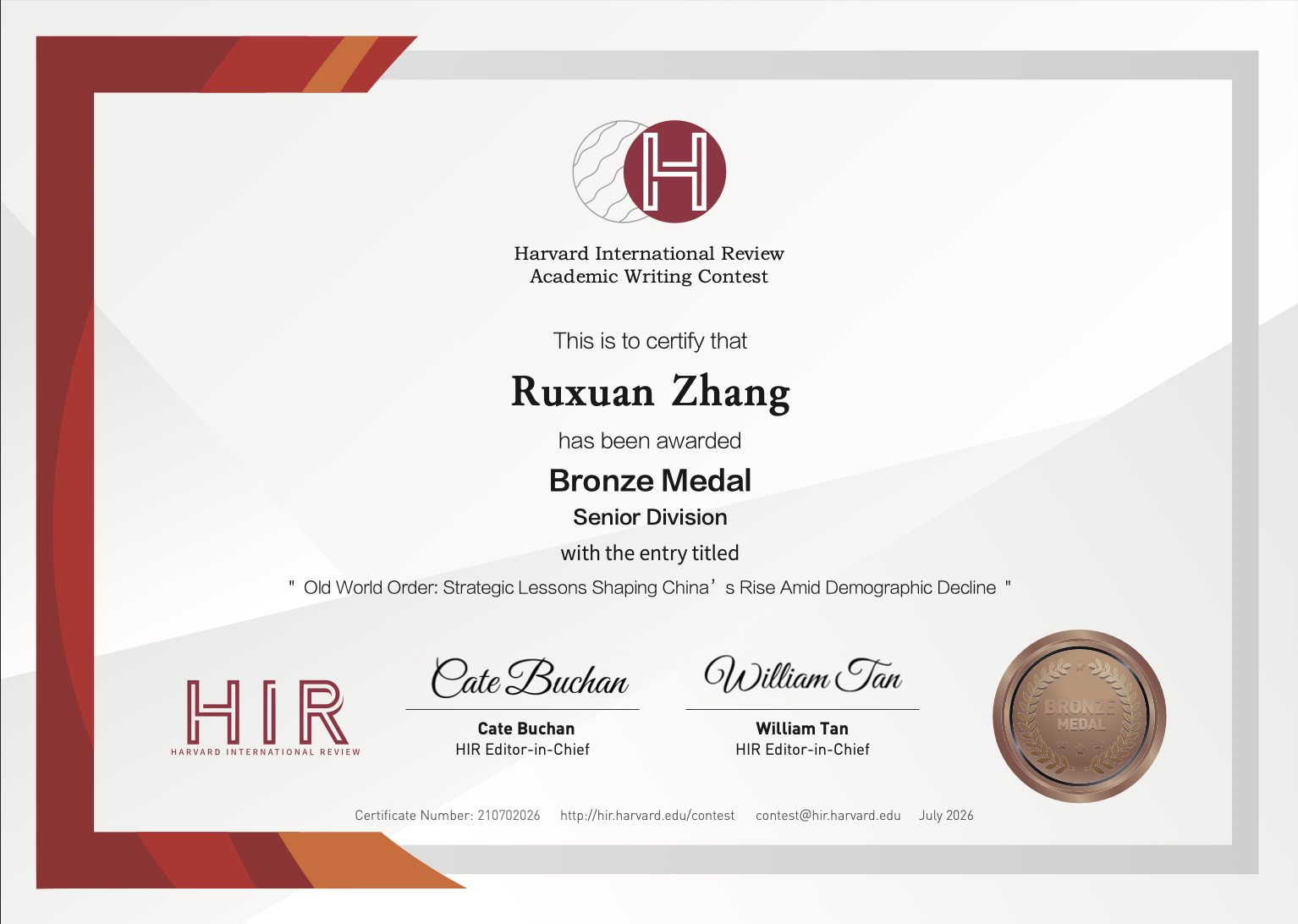
Awarded the bronze prize in the Harvard International Review Competition 2026 (Senior Division) for Theme B: Security in a Multipolar World.
When the Chinese economy began to boom in the 1990s, the United States quickly grew wary of the nation’s influence on global institutions. This mistrust of Chinese power remains a major motivator for US trade policy, coloring the trade wars of the first Trump administration, the uncharacteristic protectionism of the Democratic Biden administration, and the broad-spectrum tariffs of Trump II. Yet, despite these efforts—and missteps from the CCP—in 2026, the global stage seems to continue to shift from a stable state with the US as ‘sole superpower’, to an unstable multipolar order amid decreasing US hegemony. As current global attention remains fixed on the ramifications of the closure of the Strait of Hormuz, one wonders why China’s approach remains decidedly muted, both in regard to existing conflicts, such as the war in Ukraine, and potential future conflicts, such as Taiwan. Refraining from intervention when the United States appears to already be failing in foreign policy might be a reason for such caution; however, it could be attributed to an equally major force: demographic decline.
Historically, China has actively implemented policies to combat population concerns. Every enacted policy signals a demographic anxiety, and the shift in China’s internal regulations displays its shift in concern. Recent notable trends towards an aging population are largely the result of the one-child policy. A population planning initiative implemented in 1979, this policy restricted all families to a single child in order to address fears of overpopulation during the Cold War. It has been presumed to have prevented around 400 million births, reshaping China’s age structure for decades to come.
According to the Chinese government, in an article on supporting Chinese modernization with high-quality population development, “dominant trends in China's population development include a declining birth rate, population aging, and regional disparities in population changes”. These tendencies all contribute to a positive feedback loop in intergenerational fertility norms, in which small families tend to lead to small families themselves. In addition, the total fertility rate dropped from 1.67 in 2015 to 1.28 in 2020 despite adjustments from one-child to two-child, and even three-child policies. While it is perhaps the highest-profile example of this demographic decline, other nations face similar trends. As the global working-age population shrinks and economic growth slows, states facing such threats may feel increasing pressure to secure their international position before their relative power declines.
So, how will China respond to these demographic pressures? China’s decline is still developing; its future behavior cannot be observed directly. However, other powerful states have already experienced similar demographic stress, proving to be useful comparisons. Specifically, Russia offers a particularly important case, demonstrating how demographic decline can create a perception that time is running out.
A review of the available scholarship suggests that, to a considerable extent, shifts in relative birth rates are driving instability among powerful actors in a multipolar world, as demographic decline undermines long-term economic security while simultaneously intensifying nationalist narratives that justify assertive or coercive foreign policy behavior. While China is only beginning to experience these pressures in the past decades, Russia has already undergone a more severe and prolonged demographic decline, offering a real-world example of how such conditions can shape state behavior. Russia’s historical trajectory offers a powerful example of this dynamic. Its severe demographic collapse, shrinking workforce, and narrowing pool of military-age men created the growing belief that time won’t be on their side. This demographic pressure may have contributed to a perception among Russian leadership that delaying action would further weaken their strategic position, increasing the urgency to somehow respond. Faced with long-term contraction, Russia appeared to have acted from its sense of urgency rather than confidence. On February 24, 2022, Russia launched its full-scale invasion of Ukraine, which later resulted in economic stagnation and more than 16,500 international sanctions. As BBC News notes, the Russians’ “foreign currency reserves worth $350bn (£276bn) - about half its total reserves - were frozen. About 70% of the assets of Russian banks were also frozen”.
For China, Russia’s experience may serve less as a model than as a warning. If demographic collapse can generate population-wide insecurity and impulsive behaviours, the strain in the Russo-Ukrainian war also demonstrates the costs of acting too early, too forcefully, or without sufficient planning. A remarkable difference between China and Russia is that China still has time to make choices, whereas Russian leadership felt immediate pressure to act. From this lesson, China may conclude that premature or forceful action under demographic pressure can lead to economic isolation and long-term strategic setbacks rather than securing national strength.
This perspective helps explain several motives behind China’s recent behavior. In the 2010s, Beijing pursued ambitious projects such as the Belt and Road Initiative, Indian Ocean investments, and major domestic infrastructure expansion. These moves may have reflected an earlier confidence, when China still believed its economy and demographic momentum were able to expand aggressively. However, as pressures from slowing growth, youth unemployment, real-estate instability, and demographic contraction have recently worsened, China appears now to be more reserved and selective. As CBC News records, “that in the lead-up to Trump’s visit, Chinese naval and air activity around Taiwan has markedly declined, and China by 'dialing down' visible military pressure around Taiwan helps reinforce Beijing's new narrative and presents China as a cautious and responsible actor”. This shift suggests that China is deliberately avoiding action that could trigger international backlash, prioritizing stability and long-term positioning rather than immediate confrontation.
However, some analysts argue that China’s cautious behavior is driven more by economic challenges—the real estate crisis and slowing growth—than by demographic concerns alone. In retrospect, the Evergrande crisis and broader property-sector weakness further exposed the limits of debt-driven expansion. Rather than intensifying confrontation, Beijing seems to be favoring ambiguity, cautious foreign diplomacy, and indirect political positioning. From this perspective, population decline is only one of several pressures shaping China’s strategy. Nevertheless, these economic issues are closely tied to demographic trends, as a shrinking workforce and aging population directly contribute to reducing growth and financial instability. Ultimately, demographic decline remains a central underlying factor influencing China’s decisions.
Whether the world returns to unipolar US hegemony or remains chaotically multipolar, every actor in our global society faces the same challenge: how to maintain national strength. China’s case is especially striking because the roots of its current state lie in an intended state policy that succeeded in the short-term, but spawned the long-term structural fragility. As demographic contraction spreads globally, the future of the international power distribution may depend less on ideological rivalry alone and more on how states adapt to population scarcity, aging, and labor shortages. Ultimately, China appears to be learning that demographic decline is not only a domestic issue but also a strategic constraint, and that careful, restrained action is more sustainable than reactive or aggressive policies. In that circumstance, the central question is no longer only which power can rise to the top, but which can endure the challenge of decline most precisely. In a multipolar world, international security may belong to those who manage to hold on to what they have, rather than conquer or expand.